
Security
We use various security measures to protect our users' data and ensure the integrity of our platform.
Threat Model
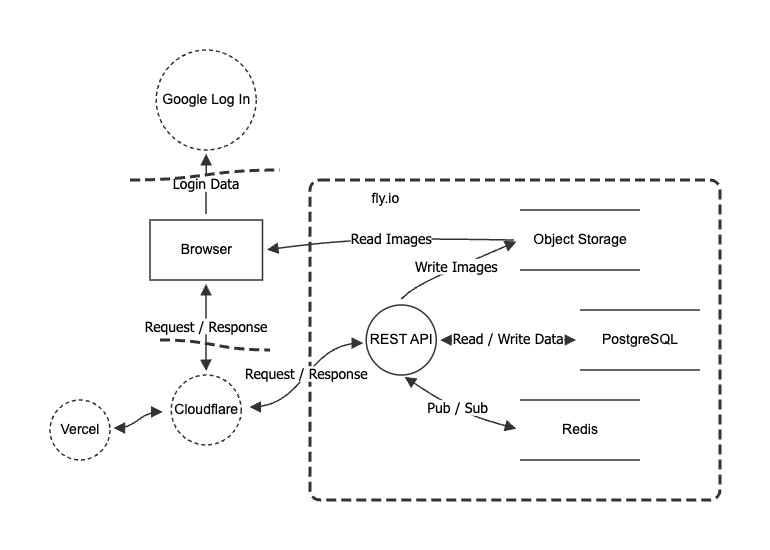
Since most of the infrastructure is hosted on fly.io, services can communicate internally with each other without the chance of interception or tampering.
General Mitigated Risks
Fly.io has a thorough security policy and gets regular security audits as can be seen here: https://fly.io/security
Similarly, Vercel also gets frequently penetration tested and even provides an application level firewall as well as bot protection: https://vercel.com/security
Browser Security
- Cross-Site Scripting (XSS): We use Content Security Policy (CSP) to prevent XSS attacks. React also sanitizes most inputs for us as long as dangerouslySetInnerHTML is avoided.
- Cross-Site Request Forgery (CSRF): We use a separate URL to host the backend, which only allows requests from our frontend. Furthermore, all API actions are required to only use application/json body, which prevents any potential XHR based attacks.
Server Security
- Denial of Service: We use Cloudflare's as well as Vercel's DDoS protection to mitigate denial of service attacks.
- SQL Injection: Prisma prevents SQL injection as long as model based queries are used.
- Command Injection: We use input validation and sanitization to prevent command injection attacks.
- Rate Limiting: We currently employ rate limiting on our auth endpoints (3 requests per 10 seconds)
Browser to Server Security
- Cross-Site Scripting (XSS): We use Content Security Policy (CSP) to prevent XSS attacks. React also sanitizes most inputs for us as long as dangerouslySetInnerHTML is avoided.
- Cross-Site Request Forgery (CSRF): We use a separate URL to host the backend, which only allows requests from our frontend. Furthermore, all API actions are required to only use application/json body, which prevents any potential XHR based attacks.
- SSL Certificate Security: We use Cloudflare encrypted SSL certificates to ensure secure communication between services.
Deployment Security
- Code Security: We use code review and static analysis tools to ensure secure code.
- Secret Leakage: We use GitGuardian to prevent leaking of secrets in the codebase.